
How do you nail it in your career?
I am privileged to mentor for the Chartered Institute of Marketing in the UK as well as a few individuals locally and am often asked for advice on career progression. Up until I moved to London in 2018, I thought I knew it all about nailing interviews and the recruitment process. As it so happens I’ve generally learnt that the minute you think you know something, you usually don’t know s**t. I went through a couple of months’ growth that have served me incredibly well, and as such, I wanted to share some of what I learned about nailing it (the CV, the interview, and the job).
The truth is that the CV, the interview and the job are all part of one element; you. It’s not enough to nail the CV if you can’t nail the interview, and it’s not enough to nail the interview if you’re not going to nail the job. It’s all one thing with you as the common denominator.
In this piece, I’m not going to tell you how to write your CV or brand yourself. Mostly because there’s a ton of information out there and how you do it now in 2025, will be different to how you do it in 2026.
But there are some core principles that do, and will, stand the test of time.
I believe that before you can brand your career, you need to understand the cornerstones of your brand.
If you’re going to nail your CV, an interview, and your job, then there are just three elements you need to pay attention to.
You be you – be authentic
The reason I believe, so many people, are unhappy in their jobs is because they’re in the wrong job or have convinced themselves that they should be something they’re not. Of course, this doesn’t mean that if you’re a rockstar at heart, you should abandon your career in auditing. Not at all. Because part of adulting means being able to pay your bills.
But perhaps there are ways to live more authentically in your career, even if you don’t change careers.
I’ll tell you this: I love building brands. I’ve never formally studied marketing; I just fell into it, and I loved it. I don’t believe marketing is something I do; it’s part of who I am.
Now accounting? That’s another story. To illustrate the example, I’ll share the fact (and I’m not proud of it) that I failed accounting not once but twice. My brain just didn’t get it. I don’t know how much money my parents wasted … I mean spent… on extra lessons, but it was too much. Eventually, I dropped out to commence another degree. When I finally accepted accounting wasn’t for me, I was free to step into other avenues far more representative of me and subjects that didn’t take half as much work but yielded far more than double the result.
If you’re naturally passionate about a subject, it’s more likely to come through in your speech and actions, thereby making it easier to sell yourself without needing to sell yourself. You’ll also be more likely to work hard and deliver. Being yourself is just one big upward spiral, really.
Become Obsessed
This could be topical. Although I believe in the principle of ikigai, I do believe that if you want to really nail something, you need to be obsessed with it.
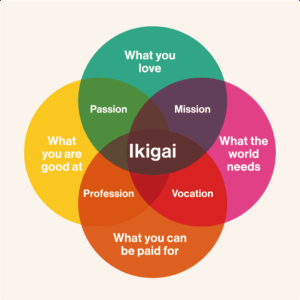
Are you obsessed with what you do? Do you read the latest articles? Do you often spend time in the shower thinking about your work? Have you picked out your dream job spec? Do you have a mentor?
If not, why not? Be obsessive about asking yourself questions until you get answers that make sense to you.
It really is okay for a job to be just a job. I get that and can respect that. Sometimes having a job leaves us time and space for thing things that really matter.
I also recognise that job obsession and passion is a privilege, if not a luxury. I’m not so sure that the petrol attendant who filled my bike with petrol is passionate about his job.
So just to be clear, I’m talking to those of you who are looking to create a career for yourself or to those of you who want to feel more than “it’s just a job”. I feel that if you’re going to spend so many hours and years of your life at work, then why not do it, doing something you love?
And if you don’t love what you do at work then at least make sure you have time and space for things in your life that you are obsessed with; kite surfing, reading, knitting, cooking, programming, learning Spanish… it doesn’t matter but make sure it gives you spark because the more spark in your soul, the more likely you are to create sparks! This means in work and otherwise!
Obsession can be both a blessing and a challenge. The art of it all is to be obsessed enough to keep yourself inspired and alive with possibility but not too much so you don’t burn out. This brings us to the very last and key element: self-management.
Learn the art of self-management
Let’s get this straight. You work for yourself. Irrespective of whether you have a boss or are self-employed, you work for you. It’s up to you to deliver, it’s up to you to make sure your work is up to scratch, it’s up to you to set deadlines, and it’s up to you to track your own performance.
In the connected economy, we need fewer managers and more leaders, so irrespective of whether you’re the receptionist, accountant, or CEO, you have a responsibility to lead. This means leading your own performance as much as it means leading others with your behaviour.
FOR EXAMPLE:
- Didn’t get a response from a job you applied for? The typical response is sadness and rejection, but the self would rather try asking questions. Do I need a different approach? Do I need to call them and find out if they received my CV? Do I need to run a LinkedIn marketing campaign to get myself noticed (This is a joke, but I have considered this in the past). I have a friend who hand-delivered his CV in a red box to potential talent acquisition managers with a card that said, “Looking for someone out of the box?” Guess what? He got a job within a day.
Self-leadership is key in nailing it. It means understanding what you need to do to get the results you want. Sometimes it means taking some downtime and recognising that you need that, and sometimes it means taking a different approach. The more you practice self-management, the more adept you become at setting and achieving targets, learning and making necessary changes when needed.
So of course, there’s the usual checklist
- Have a shit hot CV
- Do your research before an interview
And then some, but for today, I wanted to focus on the points behind the usual ‘how to’.
So go out there and #nailit
And let me know how it goes!